
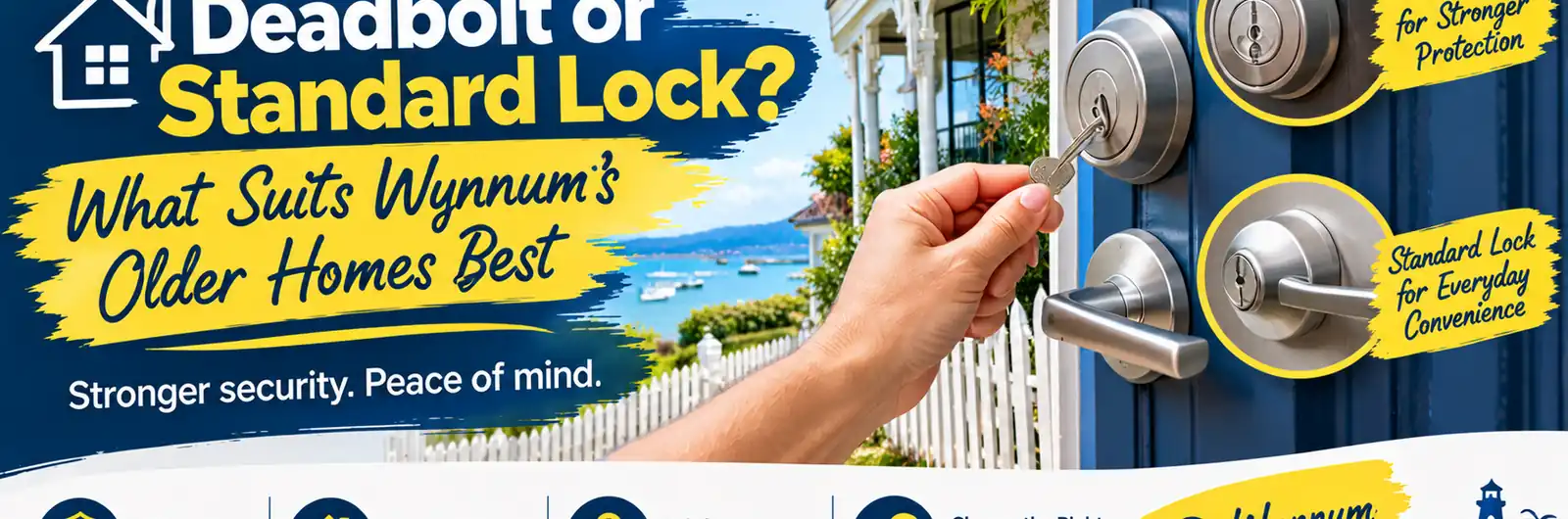
For most of Wynnum’s older homes, a deadbolt is the better choice for exterior doors, offering stronger resistance to forced entry than a standard lock alone. Standard locks still have their place, but relying on one as your only line of defence leaves character homes more exposed than most owners realise.
This guide compares deadbolts and standard locks directly, explains what suits older Queenslander-style homes specifically, and covers what to check before upgrading.
Wynnum’s mix of character homes and newer builds means the right answer isn’t always the same from one street to the next, which is why understanding both options properly matters more than following a generic rule.
Deadbolt vs Standard Lock Which Is Better
The short answer depends on where the lock sits, but for front and back doors, deadbolts win on security.
How Each Lock Type Actually Works
A deadbolt uses a solid metal bolt that extends deep into the door frame, making it far harder to force than a standard lock’s spring-loaded latch, which can sometimes be bypassed with a simple push or shim.
Security Comparison for Exterior Doors
Deadbolts resist picking, bumping, and forced entry significantly better than standard locks, which is exactly why most security guides treat them as the minimum standard for any external door.
Cost and Value Considerations
While deadbolts typically cost more upfront than a basic standard lock, the added protection usually justifies the difference, particularly on front and back doors where break-in risk is highest.
Is a Deadbolt More Secure Than a Standard Lock
Generally yes, and the reasons come down to construction rather than brand or price point.
Durability and Build Quality
Deadbolts are typically built from hardened steel or brass, allowing them to withstand far more impact and pressure than the lighter mechanisms found in standard locks.
Resistance to Common Break-In Techniques
Standard locks are more vulnerable to techniques like loiding, where a thin object pushes back the latch. A deadbolt’s solid bolt design simply doesn’t allow for that kind of bypass.
Key Control and Duplication Risk
Standard locks are generally easier to duplicate without authorisation, while higher-security deadbolt options offer better control over who can get a working copy of your key made.
“A standard lock gives the illusion of security. A deadbolt gives you the real thing.”
Best Lock Setup for Wynnum’s Older Queenslanders
Character homes bring a few extra considerations that newer builds don’t always face.
Timber Doors and Original Hardware
Many Queenslander-style homes around Wynnum still carry original timber doors and ageing lock hardware, which were rarely designed to the security standards expected today.
Pairing a Deadbolt With a Standard Lock
The most effective setup for most homes combines both: a standard lock or lever for everyday convenience, paired with a deadbolt for the heavier security layer. This gives you ease of use without compromising on protection.
Single Cylinder vs Double Cylinder Deadbolts
A single cylinder deadbolt uses a key outside and a thumb turn inside, while a double cylinder version requires a key on both sides. Double cylinder options suit doors with nearby glass panels, where a thumb turn could otherwise be reached if the glass were broken.
Vertical Deadbolts for Double or French Doors
Homes with double doors or French-style entries, common in some of Wynnum’s character properties, often benefit from a vertical deadbolt, which interlocks with the frame differently to resist the kind of leverage these door styles are more exposed to.
Installing a Deadbolt on an Older Door
Older doors sometimes need a little extra attention before a deadbolt can be properly fitted.
Checking Door and Frame Condition
If your door frame has shifted or softened over the decades, a locksmith will often need to reinforce it before a deadbolt can engage properly and provide genuine security.
Matching Hardware to a Character Home
A good installer can help match a deadbolt’s finish to your home’s existing hardware, so the upgrade blends in rather than standing out against original features.
Reinforcing the Strike Plate
A deadbolt is only as strong as the frame it bolts into, so upgrading the strike plate to a longer, reinforced version is often recommended alongside installation for genuinely improved resistance to force.
Expert tip: Always test a newly installed deadbolt several times before relying on it fully — a bolt that doesn’t fully extend offers far less protection than it appears to.
When a Standard Lock Is Still the Right Choice
Not every door needs a deadbolt, and knowing where standard locks still make sense avoids unnecessary spending.
Internal Doors and Low-Risk Areas
Standard locks remain perfectly suitable for internal doors, where convenience matters more than high-level security against forced entry.
Budget-Friendly Secondary Security
For doors already paired with a deadbolt, a standard lock adds convenient daily access without duplicating the security role the deadbolt already covers.
Signs It’s Time to Upgrade Your Current Locks
A few clear indicators suggest your current setup may not be doing its job.
Your Front Door Relies on a Standard Lock Alone
If your main entry point has never had a deadbolt fitted, that’s one of the clearest upgrade signals for any Wynnum homeowner, regardless of how new or old the property is.
Visible Wear on Existing Hardware
Rust, looseness, or difficulty turning a key are all signs that whatever lock is currently installed, deadbolt or standard, may need replacing rather than repairing.
Mismatched Keys Across Multiple Doors
If you’re juggling different keys for different doors that could realistically share one system, that’s often a sign it’s worth consolidating during any upgrade, rather than treating each lock as a separate decision.
Expert tip: A quick lock assessment every couple of years catches these issues long before they become a genuine security gap.
Choosing the Right Locksmith for Deadbolt Installation Near Wynnum
Getting the installation right matters just as much as the decision to upgrade.
Look for Experience With Older Homes
A locksmith familiar with Wynnum’s character housing stock will know exactly what to check on timber doors and older frames before installation begins.
Ask About Grading and Certification
Reputable deadbolts carry a security grading that indicates how well they resist forced entry — it’s worth asking your locksmith which grade suits your specific door and risk level.
Getting a Property-Wide Assessment
Rather than upgrading one door at a time, asking a locksmith to assess every entry point at once often reveals gaps you wouldn’t otherwise notice, and can streamline the whole upgrade into a single visit.
Conclusion
For most homes around Wynnum, pairing a deadbolt with a standard lock offers the best combination of everyday convenience and genuine security. A standard lock alone simply wasn’t built to withstand the kind of forced entry attempts a deadbolt is designed to resist.
It’s a decision that’s far easier to get right from the start than to revisit later, especially once you’ve settled into a home and life gets busy again.
If you’re weighing up a lock upgrade for an older home, a conversation with a local locksmith is the simplest way to find out exactly what your doors need.